The Philippines is not only known for its breath-taking islands and beautiful scenery, but also for its delicious food. The Filipino cuisine is a mixture of Malaysian, Indonesian, Indian, Chinese, Spanish, and American cuisine. Its cuisine shows the Philippines’ rich history and culture. Starting from 3200 BCE to the 21st century, the diversity of dishes made its cuisine stand out than the others and made its distinct flavor known around the world.
From the famous dish adobo, to the cold dessert halo-halo, Filipino food will make foreign mouths water.
Today, I will be featuring my favorite food, the vegetable lumpia or lumpiang togue (mung bean sprout)
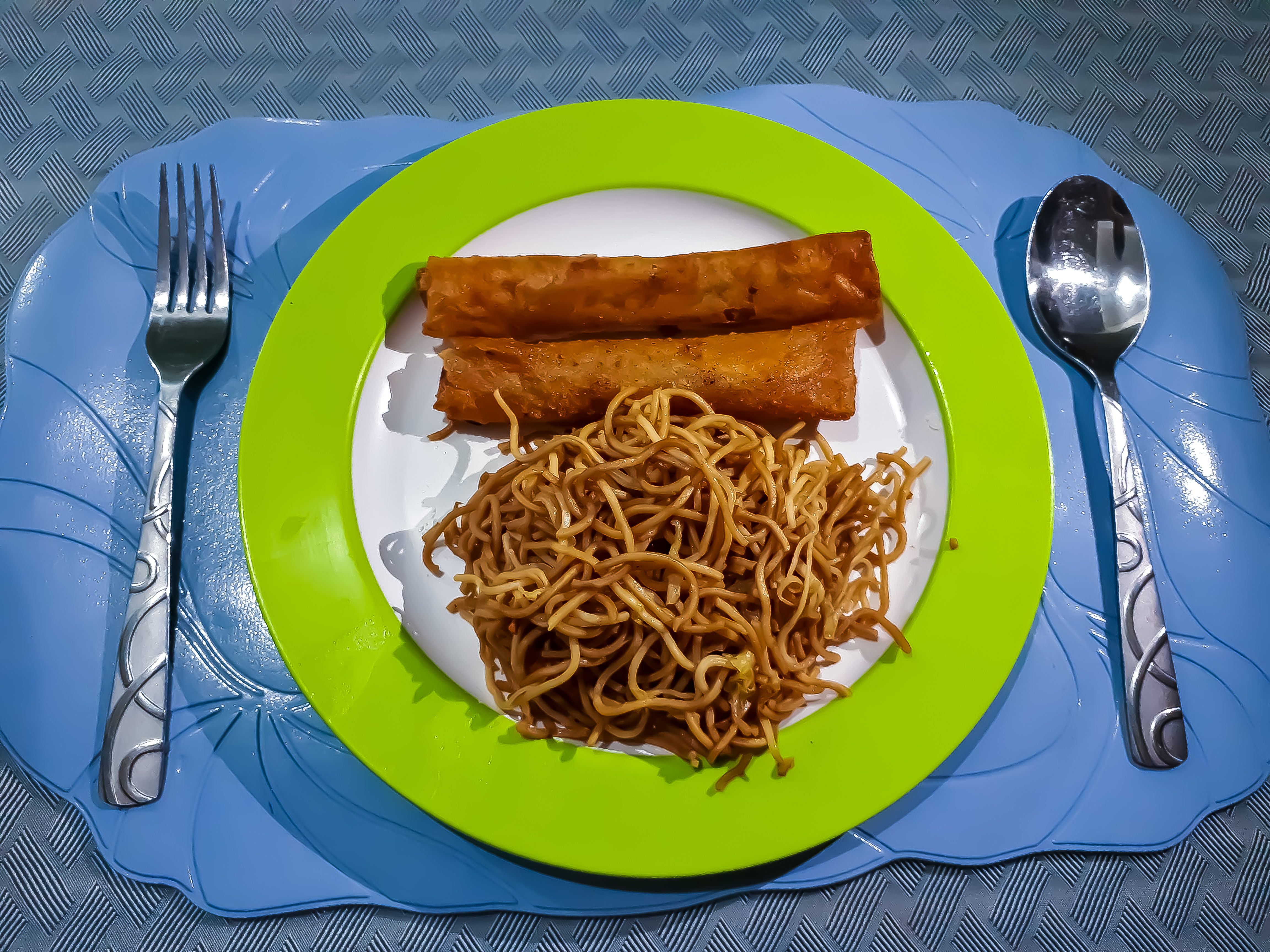
According to Wikipedia, Lumpiang gulay, also known as vegetable lumpia, is a Filipino appetizer consisting of julienned or cubed vegetables with ground meat or shrimp in a thin egg crêpe that is deep-fried. A notable variant of lumpiang gulay is lumpiang togue, which is made mostly with togue (mung bean sprouts). A popular variant of lumpiang gulay is lumpiang togue, also known as “bean sprouts lumpia” or “bean sprouts egg roll”. It is prepared roughly the same as lumpiang gulay with mostly the same ingredients. The main difference is that lumpiang togue uses more togue (mung bean sprouts) as the main ingredients, replacing the main filler of lumpiang gulay (usually cabbage). Lumpia is a spring roll of Chinese origin commonly found in the Philippines.
As you can see from the photo above, I opted for a regular pancit canton instead of rice. Pancit canton, a Filipino stir-fried noodle dish, also originates in China.
Due to the colonization of different countries and trading in the Philippines, the filipinos learned to embrace their cuisine but we shouldn’t forget the dishes that our fellow countrymen offered for us.
 Uriel's Food Blog